
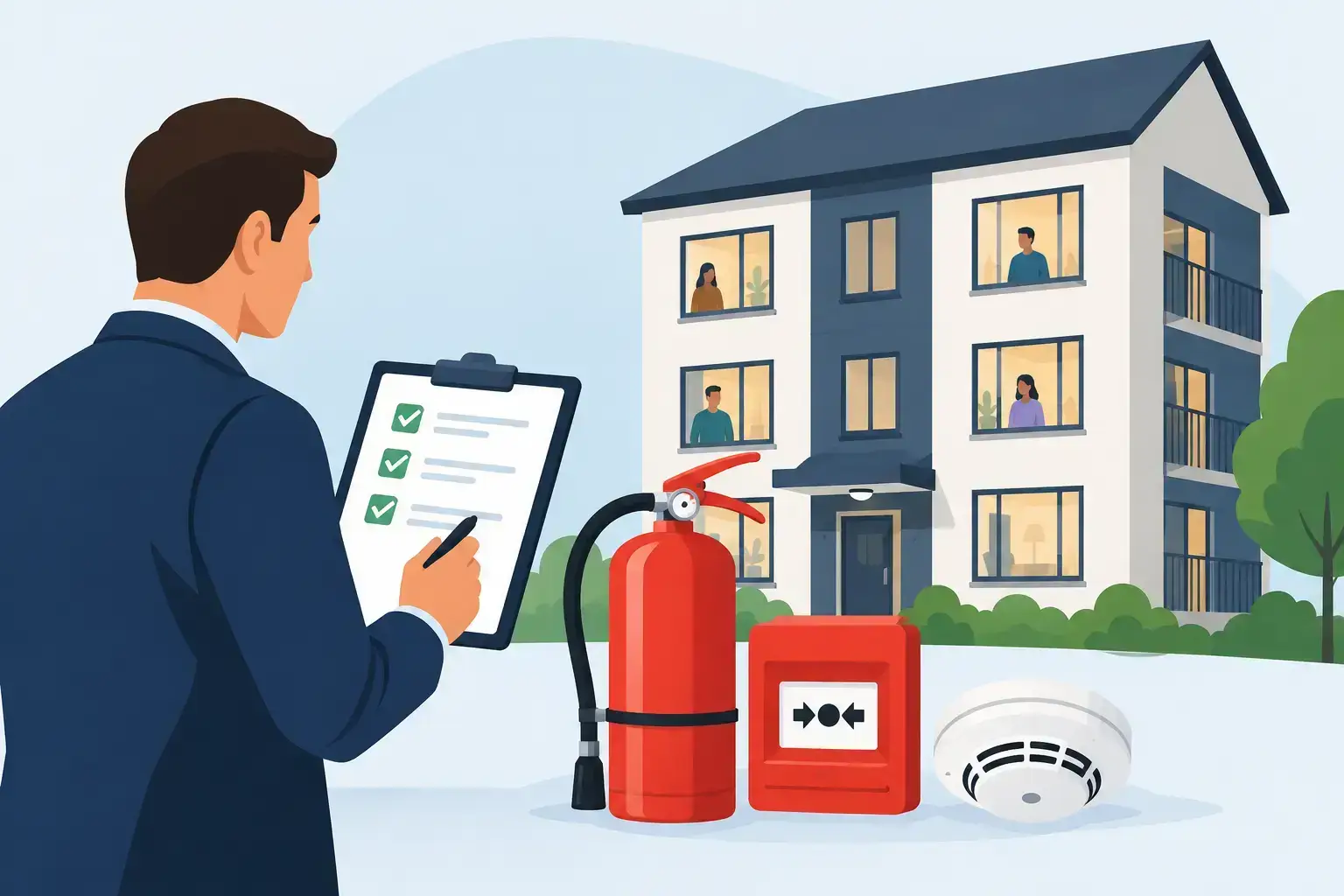
A fire safety issue in an HMO can become serious quickly. Several unrelated households may be asleep, unfamiliar with the property layout or unsure who is responsible for reporting a fault. For landlords, HMO fire safety is not simply a compliance task to complete before tenants move in. It needs clear systems, suitable equipment and regular attention throughout the tenancy.
The exact requirements depend on where the property is located, its size, layout, licence conditions and the level of risk. A shared house for three tenants is not assessed in the same way as a larger, three-storey HMO with bedsits and shared facilities. The right approach is proportionate, documented and kept under review.
Start with a property-specific fire risk assessment
A suitable fire risk assessment is the foundation of effective HMO fire safety. It identifies how a fire could start, who could be at greater risk, how people would get out and what controls are needed to reduce danger.
The assessment should look beyond the obvious. Kitchens, overloaded extension leads, smoking, candles, portable heaters and poorly maintained appliances can all create risks. So can blocked hallways, insecure fire doors, confusing escape routes and inadequate emergency lighting in larger or more complex properties.
Particular attention is needed where tenants have individual locks on bedroom doors, where the property has more than one floor, or where the route from a room to the final exit passes through a shared kitchen or living area. A resident with limited mobility, a night worker sleeping during the day or a tenant who does not speak English confidently may also need additional consideration.
A fire risk assessment should not sit in a folder indefinitely. Review it when the layout changes, occupancy increases, building work is carried out, an incident occurs or concerns are raised. Local authority licensing teams may also impose conditions that go beyond the general baseline, so the HMO licence and council guidance should always be checked.
Fire alarms and detection must suit the building
Early warning gives residents time to leave safely. In an HMO, that usually means a properly designed and maintained fire detection and alarm system rather than relying on a few standalone smoke alarms fitted wherever there is space.
The appropriate grade and coverage will depend on the property and local requirements. Larger, higher-risk or multi-storey HMOs may need a more comprehensive system, while a smaller, lower-risk house may have different expectations. A competent professional can advise on the suitable system and installation standard for the building.
Detection is only useful if it works when needed. Test alarms routinely, record the checks and arrange servicing at the required intervals. Replace batteries or units in line with the manufacturer’s instructions, and deal with fault warnings promptly. Tenants should know what the alarm sounds like, what to do when it activates and how to report a fault without delay.
Avoid treating false alarms as an inconvenience to be ignored. Repeated unwanted activations can lead residents to assume every alarm is false. Investigate the cause, whether that is cooking fumes, a poorly located detector or a faulty unit, and put a practical fix in place.
Keep the escape route protected and clear
The route from a tenant’s room to a place of safety must be usable at all times. This sounds simple, but communal hallways are often where everyday storage builds up: shoes, bikes, prams, drying racks, furniture and rubbish bags can all narrow the route or create additional fuel for a fire.
A clear-house rule is sensible: shared corridors, landings and staircases are not storage areas. This needs to be reinforced during inspections, not just stated in a tenancy agreement.
In many HMOs, fire doors form a key part of the escape strategy. A suitable fire door can slow the spread of fire and smoke, giving occupants more time to leave. Doors should close fully into their frames, have working self-closing devices where required and not be wedged open. Damaged seals, missing closers, altered door leafs and unsuitable replacement doors should be addressed quickly.
The final exit also matters. Residents must be able to open it easily from inside without searching for a key. If the property has an external gate, shared entrance or security arrangement, make sure it does not create a barrier to escape.
Make kitchens safer without making them impractical
Most HMO fires begin in kitchens, which makes sensible management essential. Shared kitchens receive heavy use, often at different times of day, and appliances can deteriorate quickly in a busy household.
Provide safe, maintainable equipment and keep enough worktop and storage space available to reduce clutter around hobs. Extractor fans should operate properly, and grease buildup should be cleaned before it becomes a hazard. Portable heaters should not be needed as a substitute for a properly maintained fixed heating system.
Electrical safety deserves the same practical approach. Landlords must meet their electrical safety duties, including arranging the required inspection and supplying the relevant report. Day to day, damaged plugs, loose sockets, overloaded adaptors and unsuitable appliances should be dealt with promptly. Tenants should be encouraged to report concerns early rather than attempting repairs themselves.
Where furniture is supplied, it must meet the relevant fire safety standards. Soft furnishings in bedrooms and communal areas should be checked when replaced, particularly where second-hand items are being considered to reduce costs.
Give tenants clear instructions from day one
A well-managed HMO makes responsibilities easy to understand. At check-in, tenants should be shown the escape route, alarm points, final exit and relevant fire safety equipment. Provide straightforward written information as well, especially in a property with frequent tenant changes.
The message should be practical: leave immediately if the alarm sounds, do not investigate a suspected fire, do not use lifts where applicable, call 999 when safe to do so, and do not re-enter until authorised. Residents should also know that tampering with detectors, disabling closers or blocking corridors puts everyone in the house at risk.
Landlords should be careful not to place fire safety responsibility entirely on tenants. Residents have a role in keeping common areas clear and reporting faults, but the landlord or managing agent needs to organise inspections, maintenance and repairs. Clear communication works best when concerns are acted on visibly and quickly.
Build HMO fire safety into routine management
The strongest approach is a planned routine rather than a reaction to inspections or complaints. Records help show what has been checked, what was found and when defects were resolved. They also make handovers between staff, contractors and managing agents much easier.
A practical management routine should cover:
- regular checks of alarms, emergency lighting where installed, fire doors and communal escape routes;
- scheduled servicing and inspection dates for relevant safety systems and electrical installations;
- prompt reporting routes for tenants, with an identified person responsible for arranging repairs;
- records of tests, maintenance, risk assessment reviews and tenant fire safety information; and
- follow-up after any alarm activation, near miss, damage or repeated breach of house rules.
There is a balance to strike. Excessive inspections can disrupt tenants and feel intrusive, while infrequent checks allow small defects to become major problems. The right frequency depends on the building, tenant turnover, previous issues and licence conditions. A professional manager should be able to set a routine that protects residents without creating unnecessary friction.
Do not rely on a one-off compliance check
Fire safety requirements can change, and council expectations can vary between areas. Work carried out to convert rooms, add locks, alter a kitchen or increase occupancy can affect the existing fire strategy. Before making changes, consider their effect on detection, containment and escape, rather than assuming the original arrangements still apply.
For HMO landlords, dependable management means treating fire safety as part of the property’s everyday operation. TWS Properties understands that this involves more than arranging a certificate or responding after a complaint. It is about maintaining a safe, workable home for residents while giving landlords confidence that key checks and actions are being managed properly.
A safe HMO is built through ordinary actions completed consistently: a clear landing, a closing fire door, a working alarm, a reported defect repaired quickly and tenants who know exactly what to do. Those details protect people first, while also protecting the long-term performance of the property.